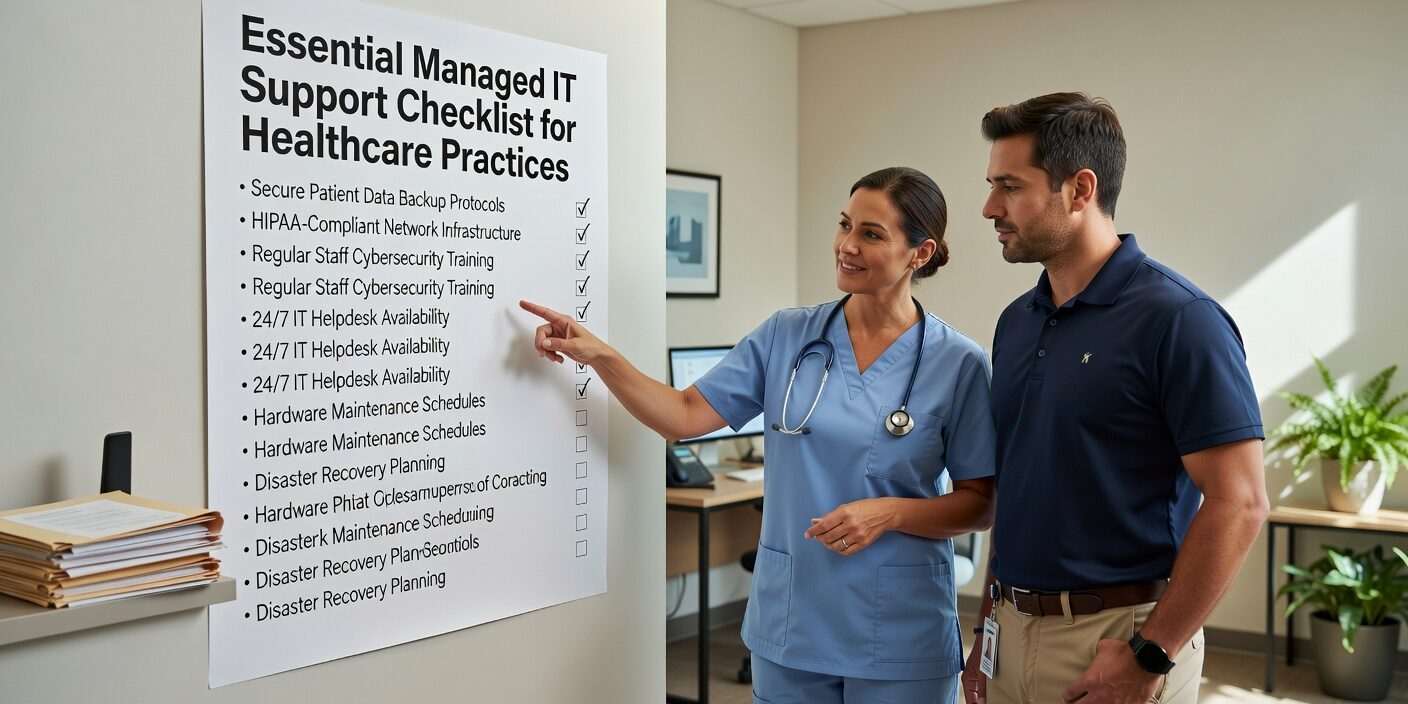
When evaluating IT support providers for your medical practice, having a comprehensive managed IT support checklist for healthcare practices ensures you make an informed decision that protects patient data and keeps operations running smoothly.
Medical practices face unique challenges that generic IT companies often don’t understand. From HIPAA compliance requirements to clinical workflow interruptions, choosing the wrong provider can expose your practice to regulatory violations, security breaches, and costly downtime.
HIPAA Compliance and Security Requirements
Your IT provider must demonstrate genuine healthcare expertise, not just basic computer support. Start by confirming they understand HIPAA Security Rule requirements and can implement proper safeguards.
Administrative Safeguards to Verify:
- Written information security program tailored to healthcare
- Security awareness training for all staff
- Role-based access controls for your EHR and practice management systems
- Documented incident response procedures
- Business continuity and disaster recovery plans with tested recovery objectives
Technical Safeguards Your Provider Should Implement:
- Multi-factor authentication for all remote access
- Encrypted data storage and transmission
- Comprehensive audit logging and monitoring
- Regular vulnerability scanning and patch management
- Next-generation endpoint protection on all devices
Ensure your provider will sign a comprehensive Business Associate Agreement that clearly defines security responsibilities, breach notification timelines, and data handling procedures.
Clinical System Support and EHR Expertise
Generic IT providers often struggle with healthcare-specific applications. Your managed IT support provider should demonstrate experience with your specific EHR platform and understand clinical workflows.
Essential Clinical Support Capabilities:
- Direct experience supporting your EHR system (Epic, Cerner, athenahealth, eClinicalWorks, etc.)
- Understanding of e-prescribing, patient portals, and telehealth platforms
- Knowledge of medical device integration and PACS systems
- Familiarity with Promoting Interoperability requirements
- Experience coordinating with EHR vendors for updates and issue resolution
Ask potential providers about recent EHR-related outages they’ve resolved and how they minimized downtime. Their response will reveal their true healthcare experience.
Backup and Disaster Recovery Planning
Medical practices cannot afford extended downtime. Your provider should implement robust backup strategies specifically designed for healthcare environments.
Critical Backup Requirements:
- Automated, encrypted backups of all patient data
- Immutable or air-gapped backup copies to prevent ransomware damage
- Clear recovery time objectives (RTO) and recovery point objectives (RPO)
- Regular backup testing with documented results
- Off-site backup storage with proper HIPAA safeguards
Request evidence of successful backup restorations, not just backup completion reports.
24/7 Monitoring and Support Capabilities
Patient care doesn’t stop after business hours, and neither should your IT support. Evaluate providers based on their ability to detect and respond to issues quickly.
Support Infrastructure to Assess:
- 24/7 security monitoring through a Security Operations Center (SOC)
- Clear escalation procedures for critical issues
- Response time commitments for different severity levels
- After-hours emergency contact procedures
- Documented service level agreements with measurable metrics
Ask for recent performance reports showing actual response times, not just promised targets.
Vendor Management and Third-Party Risk
Medical practices typically work with numerous technology vendors. Your IT provider should help manage these relationships and associated security risks.
Vendor Management Support:
- Inventory of all vendors accessing patient data
- Business Associate Agreement coordination
- Vendor security assessments and due diligence
- Integration support between different systems
- Contract renewal guidance for technology purchases
This comprehensive approach reduces your administrative burden while ensuring all vendors meet appropriate security standards.
Cybersecurity Monitoring and Threat Protection
Healthcare organizations face increasing cyber threats, making proactive security monitoring essential rather than optional.
Advanced Security Services:
- Endpoint detection and response (EDR) on all devices
- Email security with phishing protection and sandboxing
- Network monitoring and intrusion detection
- Dark web monitoring for compromised credentials
- Regular penetration testing and vulnerability assessments
- Incident response and forensic capabilities
Your provider should offer these services as standard components, not expensive add-ons.
Staff Training and Policy Development
Technology alone cannot protect your practice. Your IT provider should support comprehensive security awareness programs.
Training and Policy Support:
- HIPAA security training for all staff members
- Phishing simulation and awareness programs
- Policy templates tailored to your practice
- Regular security reminders and updates
- Documentation support for compliance audits
This educational component significantly reduces your risk of human error leading to data breaches.
Questions to Ask Potential Providers
Use this managed IT support checklist for healthcare practices when interviewing potential providers:
Healthcare Experience:
- How many medical practices do you currently support?
- Can you provide three healthcare references similar to our practice size?
- What percentage of your revenue comes from healthcare clients?
- Which EHR systems do you regularly support?
Compliance and Security:
- Will you sign a comprehensive Business Associate Agreement?
- How do you conduct HIPAA risk assessments?
- What security frameworks do you follow?
- How quickly do you respond to security incidents?
Service Delivery:
- What are your response time commitments?
- How do you handle after-hours emergencies?
- What documentation will you provide?
- How do you support our regulatory reporting needs?
Document their responses to compare providers objectively and maintain records of your due diligence process.
What This Means for Your Practice
Selecting the right managed IT provider protects your practice from compliance violations, security breaches, and operational disruptions. A comprehensive evaluation process ensures your chosen provider understands healthcare requirements and can support your clinical workflows effectively.
Remember that the lowest-cost option often becomes the most expensive when compliance issues or security incidents occur. Invest in a provider who demonstrates genuine healthcare expertise and can grow with your practice’s evolving needs.
Ready to evaluate your current IT support or find a new healthcare-focused provider? Our healthcare technology consulting guidance can help you develop a comprehensive IT strategy that protects your practice while improving operational efficiency.